
Research
Research themes
- Molecular Engineering of Photoactive Building Blocks (read more)
- Excited-State Control: Charge Transfer and Intersystem Crossing (read more)
- Photoactive Materials for Photonics and Healthcare (read more)
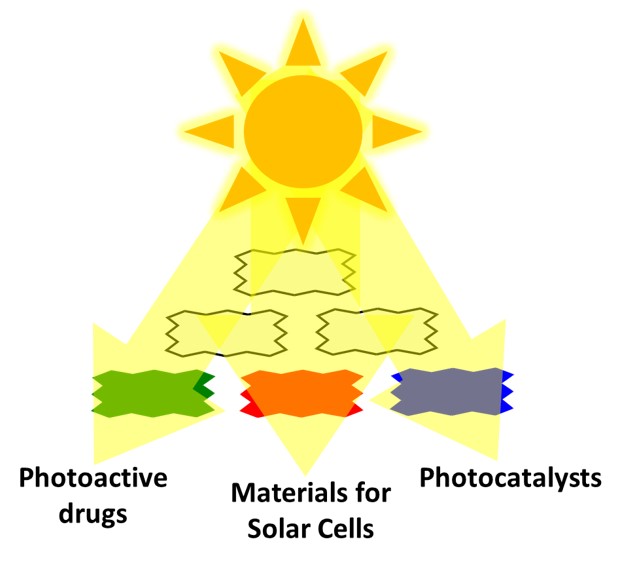
One of the central challenges in modern chemistry is to create synthetic materials whose behaviour can be controlled with a level of precision approaching that of biology. Living systems achieve complex function from simple building blocks by “programming” how molecules respond and work together. A key idea behind this research direction is that light can serve as that control handle: it can switch and combine molecular functions with high precision and can drive chemical reactions.
Light is not only a precise tool; it can also be integrated naturally into digital workflows, and AI-driven frameworks that make and adjust decisions in real time. In this sense, light can be used a practical language for programming material function. Photoactive molecules become the “alphabet” of this language: if their response to light is understood and controlled, the behaviour of materials can be written, read, and rewritten using optical and digital tools.
This philosophy motivates work at the interface of organic synthesis, photochemistry, and materials science. The focus is on photoactive molecules and materials with advanced optical behaviour - systems designed to convert light into a predictable output and to trigger controlled chemical or physical responses. By steering what happens after a molecule absorbs light, these building blocks can be translated into technologies for precision manufacturing, sensing, biomedical imaging, and energy-related light conversion.

This research is supported by Research Ireland (Taighde Éireann).